Building Knowledge
How to add doors to area separation walls in multifamily construction
Construction Services Manager Krista Karlson gives guidance on the details for “floating” doors in firewalls
Area separation walls, also known as firewalls, are a critical life-safety feature of multifamily construction because they help contain fire.
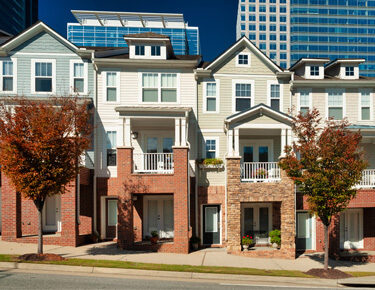
While apartment buildings, senior living facilities and dormitories, for example, may look like single buildings from the outside, they are actually constructed as a series of smaller buildings adjoined by area separation walls. When designed and installed correctly, area separation walls contain fire within one building by allowing it to collapse while the wall and the adjacent buildings behind it remain standing.
The key to a successful area separation wall installation is maintaining the structural independence of the adjoining buildings. While standard area separation wall design and construction is straightforward, adding doors in connecting corridors can present unique design challenges.
In this article Krista Karlson, construction services manager with the 1-800-NATIONAL® Construction Services team, walks through the design and installation method for doors in area separation walls found in The Wood Book™.
Designing and installing doors in area separation walls
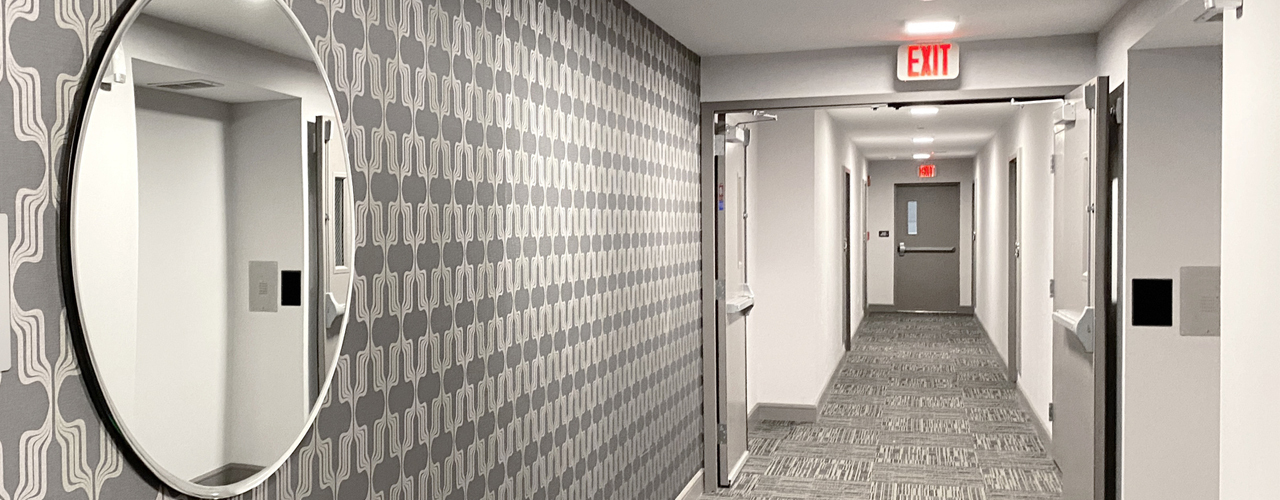
One of the most common challenges with area separation walls is the need to install doors for corridor access in large, multifamily buildings. This is especially true in apartment complexes, senior living facilities and dormitories, where a continuous corridor is needed for resident access through what are technically separate fire-rated structures.
“The challenge with putting doors in an area separation wall is that the door cannot physically connect the two buildings,” says Karlson. “The design details in The Wood Book provide a solution for supporting the door structurally within the area separation wall.”
That solution starts with designing a system where the door is supported entirely by the area separation wall itself, with no physical attachment to the adjacent buildings. This ensures that if one building collapses, the door and its frame will not pull the area separation wall down with it.
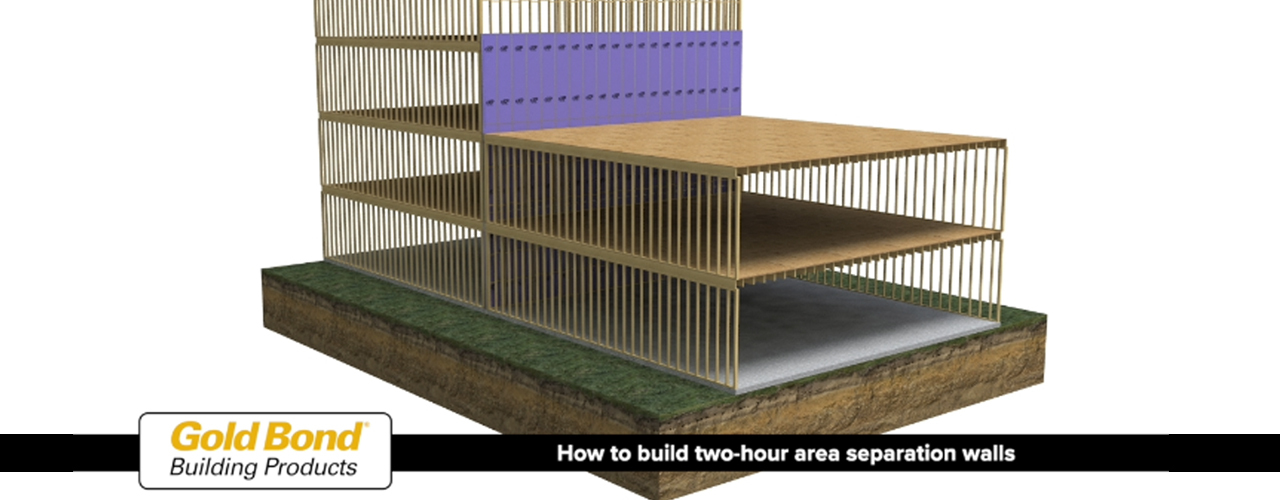
“Floating” 2-hour fire-rated doors in area separation walls
For a 2-hour fire-rated door, the key to achieving structural independence is to create a spandrel panel — a section of wall between the top of one door and the bottom of the door on the next floor — with supplemental framing to each side. These components work together like a beam to support the door.
- 8" straps: Place a 10' -long, 8" -wide strap at the top of each door frame/bottom on each spandrel to reinforce it.
- 2" steel angle: Install a 2" steel angle at the sill of each door before the next building is constructed. The angle reinforces the spandrel panel and provides an attachment point for the door sill.
- 6" steel strap: Place a 6"-wide, 20-gauge flat metal strap on top of the 2" steel angle at the sill to widen the attachment point for the door sill.
“All of these components are connected only to the area separation wall, which is attached to the adjoining buildings with special aluminum clips that are designed to burn away at 1,000 degrees Fahrenheit in a fire,” Karlson says. “This allows the door to ‘float’ within the area separation wall and maintain its structural independence.”
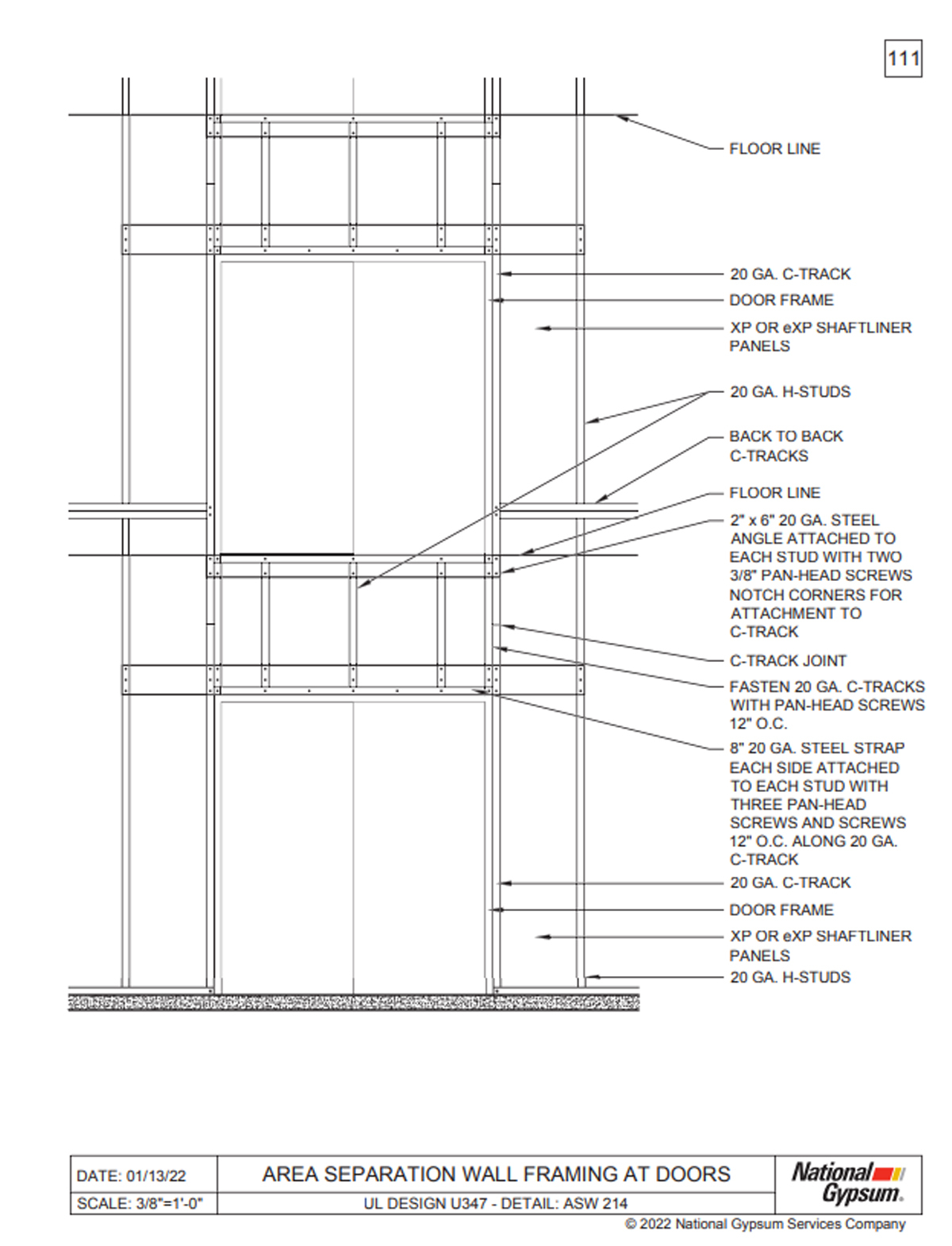 Page 111 in The Wood Book
Because these structural elements supporting the door are attached only to the area separation wall, the wall and the door maintain separation from the adjacent fire-rated buildings.
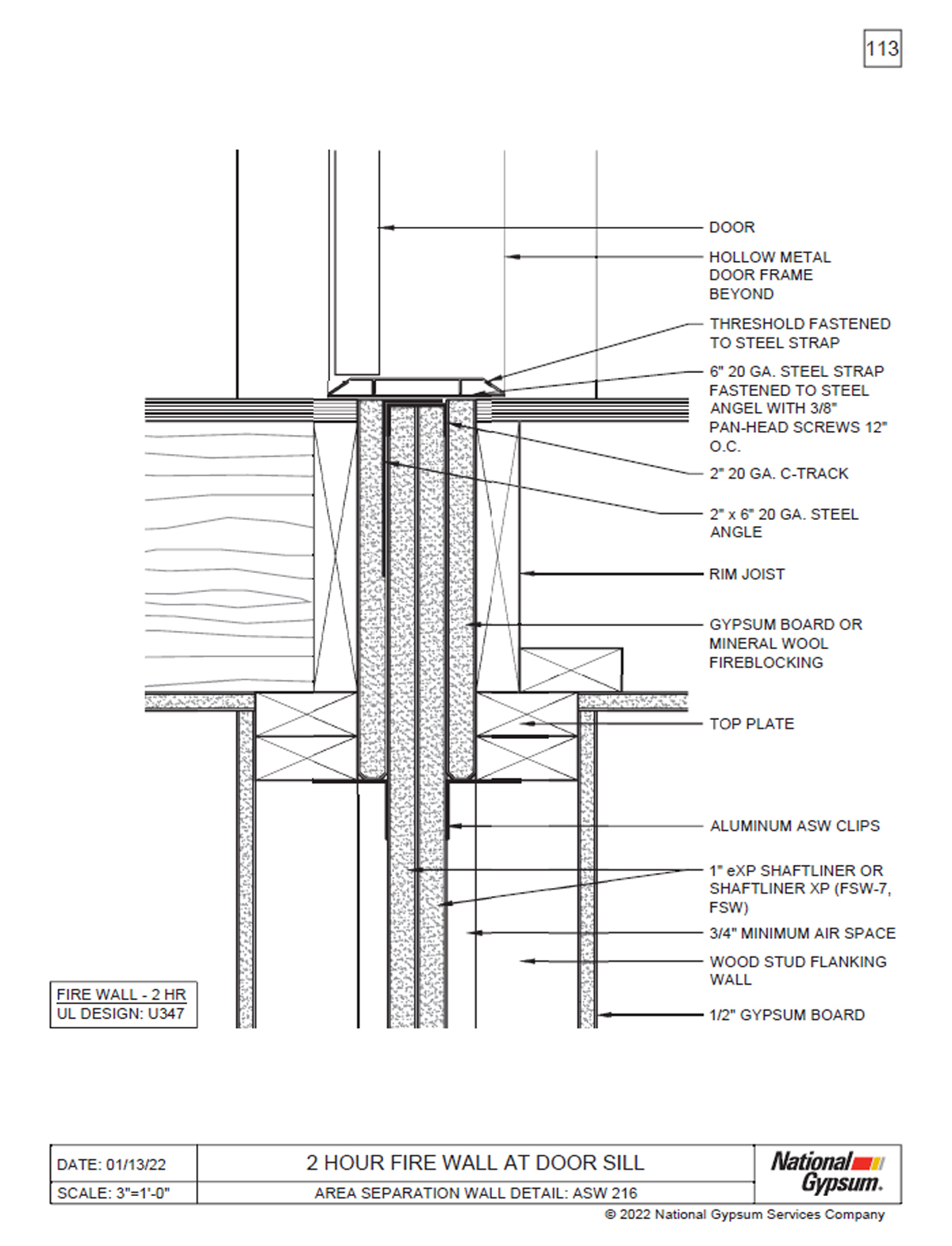 Page 113 in The Wood Book
For the head and jamb details, extra layers of 5/8" Type X gypsum board are required to be installed over the H-studs around the wall opening, and additional non-rated gypsum board may be necessary to accommodate the thickness of the wall frame. The location of the wood structural header relative to the wall and the stopping point of the wood framing are variable to suit design preferences or ease of installation.
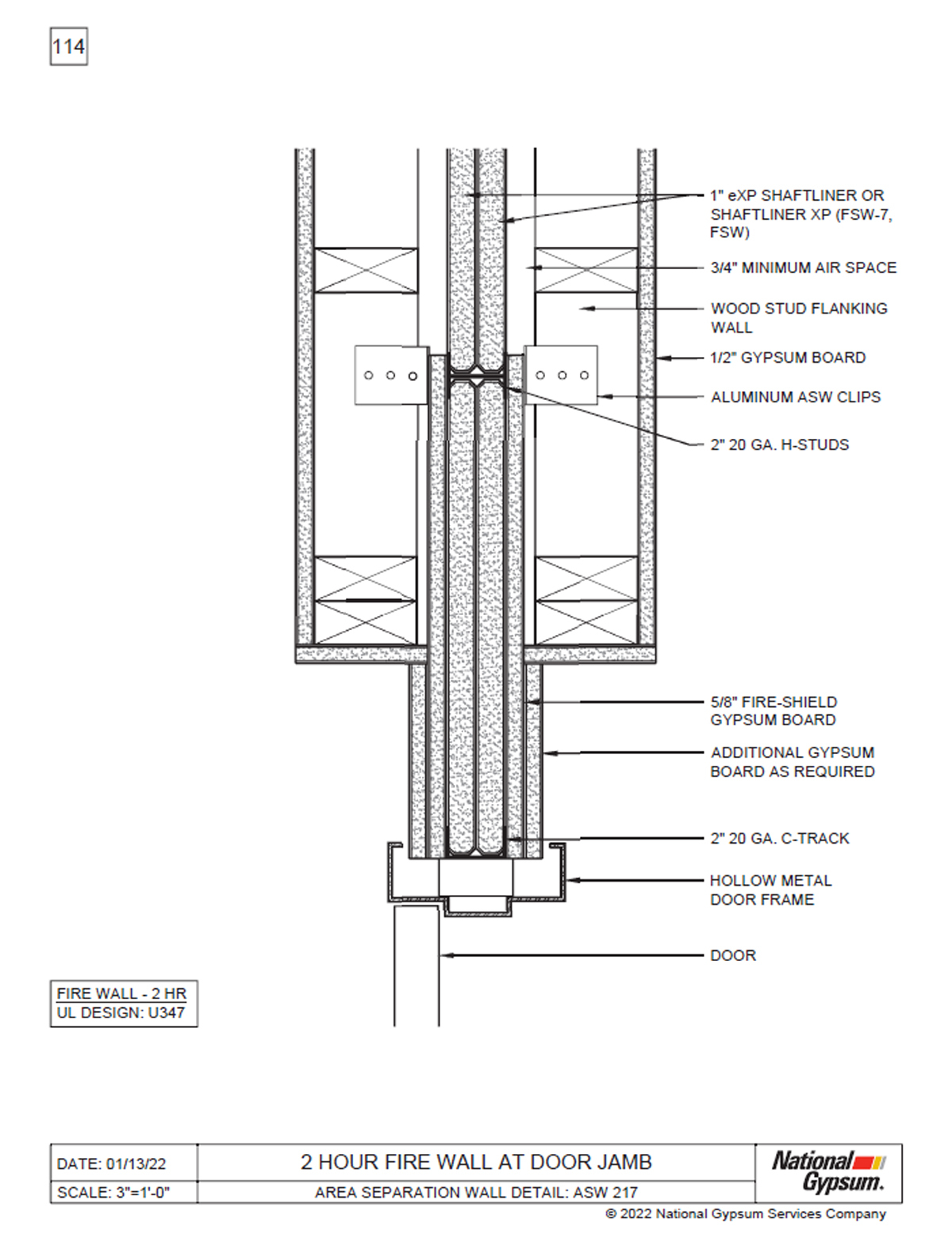 Page 114 in The Wood Book
Design considerations for 3-hour fire-rated doors in area separation walls
The framing details for 3-hour fire-rated doors are the same as for 2-hour doors, but there are a few key differences.
- The airspace in 2-hour walls is replaced by a layer of 5/8" Type C gypsum board, so no fireblocking is required.
- No additional Type X gypsum board is needed around the frame, as the 5/8" Type C is already part of the system.
Resource alert
Mar. 25, 2026
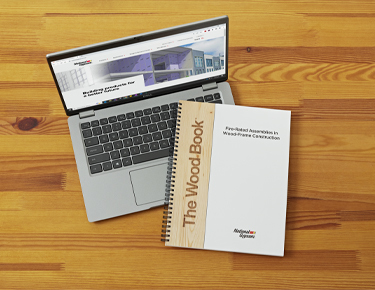
Find design details for doors in area separation walls in The Wood Book™:
• 2-hour door: pages 111-114
• 3-hour door: pages 129-132
Products and technical support to get the project done right
Gold Bond Building Products, an affiliate company of National Gypsum, manufactures all of the gypsum products required to construct area separation walls.
- Gold Bond® Shaftliner XP® Panels: A mold- and moisture-resistant paper-faced product ideal for use in area separation walls that will be dried-in immediately.
- Gold Bond Fire-Shield® Gypsum Board: A Type X core gypsum board with 5/8” thickness, providing increased resistance to fire and reduced sound transmission.
- Gold Bond® exP® Shaftliner Panels: A fiberglass-faced panel backed by a 12-month extended exposure warranty, designed for use in area separation walls likely to face weather exposure.
- Gold Bond® XP® Fire-Shield® Gypsum Board: Can be used for fireblocking and as an additional layer on each side of the H-studs in the 3-hour area separation wall.
Have Questions?
Contact the experts with the 1-800-NATIONAL® Construction Services team or your local Construction Design Manager.
Connect TodayBe the first to hear of new NGConnects Blog posts by subscribing here for early access.